Showing posts with label Architecture. Show all posts

Saturday, 15 August 2009

Skyscrapping

I have always been amazed by huge buildings that force your head upwards in astonishment, but building high and tall has been a controversial issue, especially in the U.K.


This is the Renzo Piano's design for London Bridge Tower (dubbed by the press as 'The Shard') which is currently being constructed.

There does seem to be a culturally different attitude to tall buildings. In the U.S. the skyscrappers of Manhattan are home to the rich and famous with aspirations of owning a penthouse in the sky. Whereas in the U.K. the general norm seems to oppose building upwards, in addition tower blocks are often synonymous with poverty and poor social housing.

Renzo Piano came up against many critics when designing London Bridge Tower, but managed to create a design which was inspired by church spires and gently merging into the sky. When the design was nicknamed 'The Shard', it was reversed to became more endearing term; reflecting London's scenery.


Friday, 14 August 2009

Scottish Parliament Buiding

I recently visited the city of Edinburgh. During this visit I took an excursion to the Scottish Parliament building. I was interested in the design of the building, because it was so different from the norm. It is also famous for its ‘eco-friendly’ sustainable architectural approach.

When the building opened first, it received a mixture of responses about the design. The building is probably the most abstract design of a parliament building in the world, with inspiration being taken from many sources including historic paintings.

When I viewed this building it made me think back to my previous post about the Brutalist movement (click here to view) and questioning what is right and wrong in design. Good design evokes a response, and this building certainly does that. Critically another view may-be that good design is democratic, a possible topic to debate.

Wednesday, 22 July 2009

Illinois Institute of Technology


I took these photographs at the Illinois Institute of Technology in Chicago. This particular building was designed by the architect Remmert Koolhaas. I was particularly interested in the use of texture and colour within the building. The intensity of light and colour was a key aspect in the design. The use of type, texture and pictograms were all incorporated providing a unique and consistent atmosphere to the building.

Tuesday, 21 July 2009

Chicago - A unique place for architecture and design


I recently visited the Mid-West American city which is rich with architecture, art and design. My trip consisted of visiting a number of buildings that were integral with regards to modern American architecture, and visiting noted sites in the city.

Chicago is a city that has flourished in recent history and was the first city of the skyscraper (not New York, as many would think). Below is an evaluation of a few observations I made during my trip there:

The Bean:
This sculpture is situated in Millennium Park in Chicago. It has been nicknamed 'the bean' by residents, but it is actually titled 'Cloud Gate', and is by Anglo-Indian artist Anish Kapoor. Its design is subtle in comparison to the rest of the Chicago skyline. It delicately mirrors the skyline above and the people below, providing an interactive piece to the people that surround it. It acts like a distorted mirror to those below and arround it.

As a design piece, the artist has put great consideration into how this sculpture fits into its environment, which I feel is something that applies to all design. It creates numerous responses and reaction to those that view it.

Monday, 20 July 2009

Milwaukee Art Museum

I recently visited the Milwaukee Art Museum in Wisconsin, USA which is noted for its great architecture and its sensational collection of modern art.

The museum building was built by the world renowned architect Santiago Calatrava. Its exterior was an engineering feet with steel wings that fold and unfold frequently. Calatrava's style of architecture is takes form like a sculpture with soft curves and beams; a stark contrast to the brutalist architecture I looked at previously.

The building is not the only interesting part of the museum. It features a wide variety of art and design pieces, more info can be found on their website here.

Whilst I was visiting there was an exhibit about optical illusions and colour, I took a few photos of pieces that I found particularly interesting.

The above photo is of a piece called 'Walk-In Infinity Chamber' by Stanley Landsman. Its title is descriptive of what it is. With padding on my feet I walked into a cube shaped chamber made of glass. The glass contained small lights which were reflected infinitely. The piece was recently refurbished and is one of the most popular exhibits in Milwaukee Art Museum.

I found the Milwaukee Art Museum to be symbolic of the American Mid-West. It is an example of where contemporary meets the traditional, but it also has an essence of liberalism which isn't evident everywhere in the U.S. It is difficult to be critical of somewhere which conveys so much. The museum probably does not compete to the levels of the Tate Modern or MoMA, but it does spark interest and is very insightful with a wide variety of pieces.

Monday, 29 June 2009

Brutalist Beauty

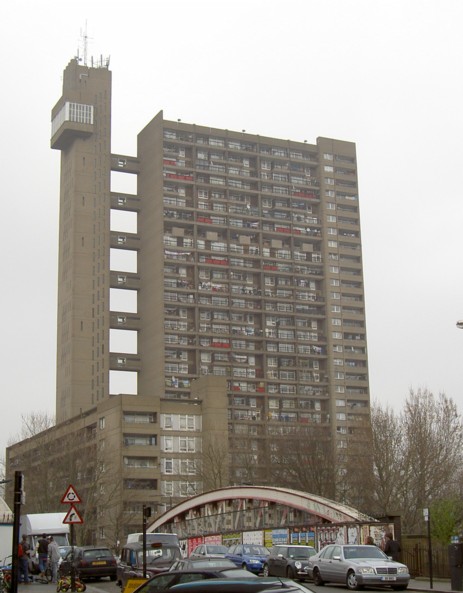
It is not often that you come across a building that was designed to have an imposing appearance that questions beauty, however Trellick Tower in West London does just that.

I pass this building often; it is hard to miss with its harsh concrete vertical appearance juxtaposed against the soft pastel low-rise terraces in Notting Hill.
Trellick Tower dominates the West London sky-line.

The building comes under the appropriately named 'brutalist' movement of architecture, and was designed by the architect Erno Goldfinger.

During the 1980's along with many high rises the building suffered a bad reputation for crime. Its discreet corridors and bare concrete walls becoming a place of fear. More recently the building has become a cult icon and appreciated for its unique architecture; appreciated so much that it is now considered a Grade II* listed building. It raises many questions in regards to design and beauty, mainly who is to judge?

The main principle in architecture is that form follows function, and therefore the design should primarily be designed with its purpose in mind. Trellick Tower appears to have no superfluous design. Its function which makes up its form can be appreciated and its appearance giving the viewer different sentiments.

More about the building can be found out here.